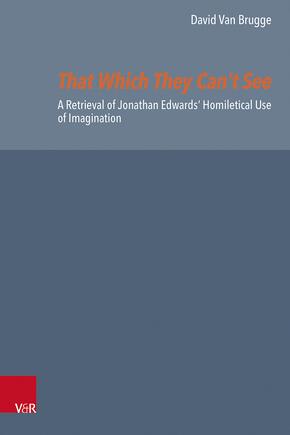
That Which They Can't See - A Retrieval of Jonathan Edwards' Homiletical Use of Imagination
Reduzierte Artikel in dieser Kategorie

10,99 €
| Verlag | Vandenhoeck & Ruprecht |
| Auflage | 20.01.2025 |
| Seiten | 308 |
| Format | 16,3 x 2,3 x 23,6 cm |
| Gewicht | 615 g |
| Artikeltyp | Englisches Buch |
| Reihe | Reformed Historical Theology |
| ISBN-10 | 3525502087 |
| EAN | 9783525502082 |
| Bestell-Nr | 52550208A |
In this retrieval study David Van Brugge addresses how the current understanding of a homiletical use of imagination for expository preaching might be strengthened. The current need for strengthening becomes apparent when the various understandings of imagination and their implications for practical theology are realized. This is compounded as trends in homiletics seem to minimize the imagination or embrace it in modern or postmodern ways.
The original contribution of this study is recognizing that the homiletical use of imagination can be strengthened by retrieving the Puritan baroque characteristics of Jonathan Edwards' imagination as evidenced in his sermons to the Stockbridge Indians of 1751-1758. Edwards drew on a rich background to display an imagination that synthesized thoughts and ideas, thought beyond the senses, and that, by the grace of God, transformed thought and practice. Through that creative thought, Edwards maintained Biblical exposition and appeal to the affections.
Van Brugge further develops and evaluates the idea of Puritan baroque characteristics, concluding that it is a helpful characterization of Edwards' Stockbridge Indian sermons. In these sermons Edwards imaginatively used imagery, light, space, movement, and glorification for the ultimate goal of directing the affections of his audience towards God. Such a use of imagination for affective purpose becomes a key for the strengthening of a homiletical use of imagination today.
