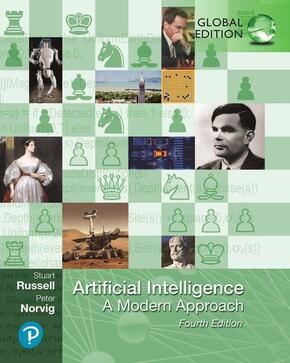
Artificial Intelligence: A Modern Approach, Global Edition
Taschenbuch, Sprache: Englisch - zu den Produktdetails
90,49 €
inkl. MwSt. versandkostenfrei!
Reduzierte Artikel in dieser Kategorie

Preisbindung aufgehoben3
6,99 €18,95 €3
6,99 €
Produktdetails
| Verlag | Pearson |
| Auflage | 4. Auflage, 13.05.2021 |
| Seiten | 1168 |
| Format | 20,5 x 4,3 x 25,5 cm |
| Gewicht | 2096 g |
| Artikeltyp | Englisches Buch |
| EAN | 9781292401133 |
| Bestell-Nr | 29240113UA |
Produktbeschreibung
Thelong-anticipated revision of ArtificialIntelligence: A Modern Approach explores the full breadth and depth of the field of artificialintelligence (AI). The 4th Edition brings readers up to date on the latest technologies,presents concepts in a more unified manner, and offers new or expanded coverageof machine learning, deep learning, transfer learning, multi agent systems,robotics, natural language processing, causality, probabilistic programming,privacy, fairness, and safe AI.
Inhalt:
Chapter I Artificial Intelligence
- Introduction
- What Is AI?
- The Foundations of Artificial Intelligence
- The History of Artificial Intelligence
- The State of the Art
- Risks and Benefits of AI
- Intelligent Agents
- Agents and Environments
- Good Behavior: The Concept of Rationality
- The Nature of Environments
- The Structure of Agents
- Solving Problems by Searching
- Problem-Solving Agents
- Example Problems
- Search Algorithms
- Uninformed Search Strategies
- Informed (Heuristic) Search Strategies
- Heuristic Functions
- Search in Complex Environments
- Local Search and Optimization Problems
- Local Search in Continuous Spaces
- Search with Nondeterministic Actions
- Search in Partially Observable Environments
- Online Search Agents and Unknown Environments
- Constraint Satisfaction Problems
- Defining Constraint Satisfaction Problems
- Constraint Propagation: Inference in CSPs
- Backtracking Search for CSPs
- Local Search for CSPs
- The Structure of Problems
- Adversarial Search and Games
- Game Theory
- Optimal Decisions in Games
- Heuristic Alpha--Beta Tree Search
- Monte Carlo Tree Search
- Stochastic Games
- Partially Observable Games
- Limitations of Game Search Algorithms
- Logical Agents
- Knowledge-Based Agents
- The Wumpus World
- Logic
- Propositional Logic: A Very Simple Logic
- Propositional Theorem Proving
- Effective Propositional Model Checking
- Agents Based on Propositional Logic
- First-Order Logic
- Representation Revisited
- Syntax and Semantics of First-Order Logic
- Using First-Order Logic
- Knowledge Engineering in First-Order Logic
- Inference in First-Order Logic
- Propositional vs. First-Order Inference
- Unification and First-Order Inference
- Forward Chaining
- Backward Chaining
- Resolution
- Knowledge Representation
- Ontological Engineering
- Categories and Objects
- Events
- Mental Objects and Modal Logic
- for Categories
- Reasoning with Default Information
- Automated Planning
- Definition of Classical Planning
- Algorithms for Classical Planning
- Heuristics for Planning
- Hierarchical Planning
- Planning and Acting in Nondeterministic Domains
- Time, Schedules, and Resources
- Analysis of Planning Approaches
- Quantifying Uncertainty
- Acting under Uncertainty
- Basic Probability Notation
- Inference Using Full Joint Distributions
- Independence 12.5 Bayes' Rule and Its Use
- Naive Bayes Models
- The Wumpus World Revisited
- Probabilistic Reasoning
- Representing Knowledge in an Uncertain Domain
- The Semantics of Bayesian Networks
- Exact Inference in Bayesian Networks
- Approximate Inference for Bayesian Networks
- Causal Networks
- Probabilistic Reasoning over Time
- Time and Uncertainty
- Inference in Temporal Models
- Hidden Markov Models
- Kalman Filters
- Dynamic Bayesian Networks
- Making Simple Decisions
- Combining Beliefs and Desires under Uncertainty
- The Basis of Utility Theory
- Utility Functions
- Multiattribute Utility Functions
- Decision Networks
- The Value of Information
- Unknown Preferences
- Making Complex Decisions
- Sequential Decision Problems
- Algorithms for MDPs
- Bandit Problems
- Partially Observable MDPs
- Algorithms for Solving POMDPs
- Multiagent Decision Making
- Properties of Multiagent Environments
- Non-Cooperative Game Theory
- Cooperative Game Theory
- Making Collective Decisions
- Probabilistic Programming
- Relational Probability Models
- Open-Universe Probability Models
- Keeping Track of a Complex World
- Programs as Probability Models
- Learning from Examples
- Forms of Leaming
- Supervised Learning .
- Learning Decision Trees .
- Model Selection and Optimization
- The Theory of Learning
- Linear Regression and Classification
- Nonparametric Models
- Ensemble Learning
- Developing Machine Learning Systen
- Knowledge in Learning
- A Logical Formulation of Learning
- Knowledge in Learning
- Exmplanation-Based Leaening
- Learning Using Relevance Information
- Inductive Logic Programming
- Learning Probabilistic Models
- Statistical Learning
- Learning with Complete Data
- Learning with Hidden Variables: The EM Algorithm
- Deep Learning
- Simple Feedforward Networks
- Computation Graphs for Deep Learning
- Convolutional Networks
- Learning Algorithms
- Generalization
- Recurrent Neural Networks
- Unsupervised Learning and Transfer Learning
- Applications
- Reinforcement Learning
- Learning from Rewards
- Passive Reinforcement Learning
- Active Reinforcement Learning
- Generalization in Reinforcement Learning
- Policy Search
- Apprenticeship and Inverse Reinforcement Leaming
- Applications of Reinforcement Learning
- Natural Language Processing
- Language Models
- Grammar
- Parsing
- Augmented Grammars
- Complications of Real Natural Languagr
- Natural Language Tasks
- Deep Learning for Natural Language Processing
- Word Embeddings
- Recurrent Neural Networks for NLP
- Sequence-to-Sequence Models
- The Transformer Architecture
- Pretraining and Transfer Learning
- State of the art
- Robotics
- Robots
- Robot Hardware
- What kind of problem is robotics solving?
- Robotic Perception
- Planning and Control
- Planning Uncertain Movements
- Reinforcement Laming in Robotics
- Humans and Robots
- Alternative Robotic Frameworks
- Application Domains
- Computer Vision
- Introduction
- Image Formation
- Simple Image Features
- Classifying Images
- Detecting Objects
- The 3D World
- Using Computer Vision
- Philosophy, Ethics, and Safety of Al
- The Limits of Al
- Can Machines Really Think?
- The Ethics of Al
- The Future of AI
- Al Components
- Al Architectures
- A.1 Complexity Analysis and O0 Notation
- A.2 Vectors, Matrices, and Linear Algebra
- A.3 Probability Distributions
- Bibliographical and Historical Notes
- B.1 Defining Languages with Backus-Naur Form (BNF)
- B.2 Describing Algorithms with Pseudocode
- B.3 Online Supplemental Material
Bibliography
Index
Mehr Angebote zum Thema
