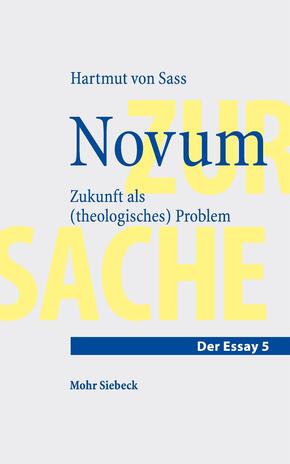
Novum - Zukunft als (theologisches) Problem
Reduzierte Artikel in dieser Kategorie

10,99 €
| Verlag | Mohr Siebeck |
| Auflage | 16.01.2026 |
| Seiten | 107 |
| Format | 11,3 x 0,5 x 18,2 cm |
| Broschur | |
| Gewicht | 100 g |
| Reihe | Zur Sache. Der Essay |
| ISBN-10 | 3162001773 |
| ISBN-13 | 9783162001771 |
| Bestell-Nr | 16200177A |
We should be interested in the future, if only because we will spend the rest of our lives in it. We have always related to the future in particular ways. Moreover, we evaluate imagined futures, and these evaluations affect the present, in which we already live together in anticipation, hope, expectation, or uncertainty - even resignation. Certain future scenarios require a concrete attitude from us, so that we must prepare ourselves and also consider the well-being of coming generations. Some broader orientations of life already contain rather concrete notions of how we should relate to the future. Hartmut von Sass examines these four levels of factual, evaluative, normative, and implicative relations to the future in greater depth, to eventually ask what attitudes toward the future and accompanying emotions the Christian faith already embodies - and this in the face of concrete challenges of a present whose future has become fundamentally uncertain. Yet this undertaking encounters a theological reservation concerning questions of last and penultimate things. Therefore, the general and theologically related question of the future is bound up with a recovery of eschatological interests. The author first rejects the two traditional approaches that either understand Christian images of the future realistically as outstanding facts or that weaken them by declaring everything a pure or impure symbol. The moments of truth in both approaches are preserved, while their pitfalls are avoided by situating eschatology within a practice-theoretical framework. Hartmut von Sass thus asks how the future - as eternal life, God's kingdom, and resurrection into a new life - emerges through and within the practices of faith. In doing so, it becomes clear what strong assumptions faith carries in this regard: despair is suggested as a form of 'sin,' whereas hope appears as one of the virtuous elements of faith itself. Finally, it is to be asked in what sense this promising faith might be linked with corresponding political concerns. Likewise, it is to be considered how God and the future relate to each other if one takes seriously the well-founded assumption that God himself has an open, still possible, and thus not predetermined future.
Inhalt:
Auftakt. Von der Zukunft her
I. Expositionen
1. Zukunft als große Erzählung
2. Zwei oder drei Begriffe der Zukunft
3. Zukunft, die frühen Jahre
4. Regime der Zeit
II. Sich zur Zukunft verhalten
1. future relations: vier Varianten
2. Zukunft als Existenzial
3. Zukunftspraktiken
4. Definitorisch: Theorie des Propheten
III. Zukunft als Norm
1. Eine Pflicht zur Zukunft?
2. Etwas versprechen
3. Emotionen der Zukunft
4. Tod
IV. Zukunft als theologisches Problem
1. Eine Sprache der Zukunft
2. Novum
3. Wiedergewinnung der Zukunft
4. Zukunftspolitik?
V. Der Gott der Zukunft
