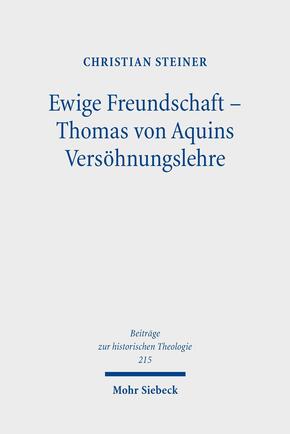
Ewige Freundschaft - Thomas von Aquins Versöhnungslehre - Versöhnung als trinitarisch begründetes Freundschaftsgeschehen zwischen Gott und Mensch
Reduzierte Artikel in dieser Kategorie

| Verlag | Mohr Siebeck |
| Auflage | 15.07.2026 |
| Seiten | 374 |
| Format | 16,4 x 24,4 x 2,7 cm |
| Gewicht | 702 g |
| Reihe | Beiträge zur historischen Theologie / BHTh |
| ISBN-10 | 3162000300 |
| ISBN-13 | 9783162000309 |
| Bestell-Nr | 16200030A |
Christian Steiner develops a systematic-theological reconstruction of Thomas Aquinas's doctrine of reconciliation under the guiding concept of amicitia Dei. His central thesis holds that, for Aquinas, reconciliation is neither a juridical transaction nor a moral model, but a Trinitarianly grounded event of friendship between God and humanity. In this perspective, cross, incarnation, satisfaction, and grace appear as expressions of a divine initiative aimed at eternal communion. The author demonstrates that the concept of eternal divine friendship possesses both hermeneutical and conceptual strength: it integrates classical theories of atonement - satisfaction, moral, and penal theory - without reproducing their limitations, and unites key dogmatic loci - Trinity, creation, cross, grace, and consummation - within a coherent relational framework. The argument is specified in four theological focal points: justice is understood as the ordered form of love; Christ bears the cross in blessed and voluntary obedience; vicarious satisfaction is interpreted as the act of divine-human solidarity in friendship; and grace enables genuine human cooperation within the communio amicitiae. In this way, a Trinitarian soteriology emerges in which God's self-communication is conceived as friendship. Christian König thus opens the view toward a theology that mediates between classical dogmatics and a personal-relational hermeneutic while offering new perspectives for ecumenically receptive and post-metaphysically responsible theologies of grace.
