Reduzierte Artikel in dieser Kategorie

7,99 €
| Verlag | Evangelische Verlagsanstalt |
| Auflage | Dezember 2018 |
| Seiten | 144 |
| Format | 12,9 x 19,2 x 1,2 cm |
| Großformatiges Paperback. Klappenbroschur | |
| Gewicht | 166 g |
| Reihe | Große Texte der Christenheit (GTCh) |
| ISBN-10 | 3374056695 |
| ISBN-13 | 9783374056699 |
| Bestell-Nr | 37405669A |
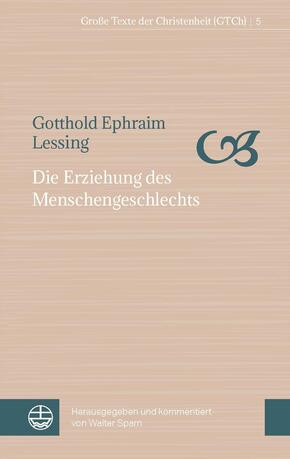
Gotthold Ephraim Lessings Skizze von 1777/1780 bot seinen Zeitgenossen eine Bestimmung ihres Standorts in der Neuzeit an und begründete das im Rahmen einer Kultur- und Religionsgeschichte der ganzen Menschheit. Das war philosophisch und theologisch riskant, weil es den revolutionären Wechsel eines basalen Paradigmas bedeutete: Die zeitlich geschlossene Heilsgeschichte wird zu einer offenen Entwicklungsgeschichte, geprägt durch humanen Fortschritt und göttliche Pädagogik zugleich. Der Kommentar erklärt die Logik und das Pathos des Textes und stellt ihn in den Kontext der Debatten über Aufklärung, Bildung und Christentum. Insbesondere kontrastiert er mit Lessing das traditionelle Modell und das Modell I. Kants und seiner idealistischen bzw. materialistischen Nachfolger. Schließlich werden Aktualität und Ambivalenz des chiliastischen Paradigmas Lessings diskutiert.
Gotthold Ephraim Lessing's sketch of 1777/1780 offered his contemporaries a clarification of their position in the modern age; he justified this in the context of a cultural and religious history of whole humankind. This was risky from philosophical and theological points of view, because it meant the revolutionary change of a basal paradigm: the temporally finite history of salvation now becomes a history of open evolution, characterized by human progress and divine pedagogy equally. The commentary explains the logic and the pathos of the text and sets it in the context of the debates on Enlightenment, Education and Christianity. In particular, it contrasts with Lessing the traditional paradigm and the one of Immanuel Kant and his idealistic resp. materialistic successors. Finally, the current relevance and ambivalence of Lessing's chiliastic paradigm are discussed.
