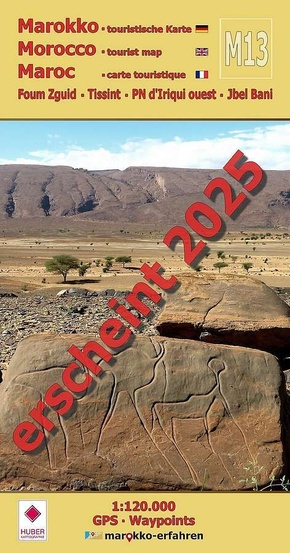
M13: Foum Zguid - Tissint - PN d'Iriqui ouest - Jbel Bani - Marokko Touristische Karte
Reduzierte Artikel in dieser Kategorie

2,99 €
| Verlag | Huber Kartographie |
| Auflage | 2025 |
| Format | 10,5 x 0,8 x 20,0 cm |
| Gewicht | 65 g |
| Artikeltyp | Karte |
| Reihe | Touristische Landkarten Marokko 1:120.000 |
| ISBN-10 | 3943752879 |
| EAN | 9783943752878 |
| Bestell-Nr | 94375287A |
M13: Foum Zguid - Tissint - PN d'Iriqui ouest - Jbel BaniGerman / English / French| 1:120,000 | approx. 84 x 59 cm | folded 10.5 x 20 cm | numerous photos | ISBN 9783943752878 |If you would like to contribute something, have goals or recommendations or would like to be informed about news, please send an e-mail to marokko-erfahren[at]arcor.de.East of Tata, the area becomes drier and more barren. Between Tissint and Foum Zguid, south of Jbel Bani, you can already sense a hint of the desert. No wonder, as you can reach Erg Chegaga and Lac Iriqui from here.Charles de Foucauld travelled the area extensively and stayed in Tissint several times during his stay in Morocco. His descriptions and sketches help us to familiarise ourselves with and understand life here 150 years ago. They give an impression of even more luxuriant fauna and flora and are easy to read on the spot.A few years after Foucauld, Marquis René de Segonzac travelled through the area and left behind interesting information and his first photos.Lovers of rock art should take plenty of time to discover the numerous sites - most of which adorn the crests of the hills - with their fascinating images in stone.Numerous stone monuments, here also in special shapes such as croissants or antennae, are reminders of the once intensive colonisation.In the sparsely populated region, architectural sights are rarer, but no less worth seeing.Cartography: marokko-erfahren, cartographic advice Prof. Dr Uwe Ulrich Jäschke
M13 : Foum Zguid - Tissint - PN d'Iriqui ouest - Jbel Baniallemand / anglais / français| 1:120.000 | env. 84 x 59 cm | plié 10,5 x 20 cm | nombreuses photos | ISBN 9783943752878 |Contribuer, avoir des objectifs, des recommandations ou être informé des nouveautés, envoyez un mail à marokko-erfahren[at]arcor.de.A l'est de Tata, la région devient plus sèche, plus aride. Entre Tissint et Foum Zguid, au sud du Jbel Bani, on sent déjà un air de désert. Ce n'est pas étonnant, car c'est d'ici que l'on accède à l'erg Chegaga et au lac Iriqui.Charles de Foucauld a déjà parcouru la région de manière intensive et a séjourné à plusieurs reprises à Tissint lors de son séjour au Maroc. Ses descriptions et croquis aident à connaître et à comprendre la vie ici il y a 150 ans. Ils donnent une idée de la faune et de la flore encore plus luxuriantes et se lisent facilement sur place.Quelques années après Foucauld, le marquis René de Segonzac a parcouru la région et a laissé des informations intéressantes et les premières photos.Les amateurs d'art rupestre devraient prendre tout leur temps pour découvrir les nombreux sites - qui ornent généralement les crêtes des collines - et leurs fascinantes images en pierre.De nombreux monuments en pierre, ici aussi dans des formes spéciales comme par exemple un croissant ou une antenne, rappellent l'occupation intensive d'autrefois.Dans cette région peu peuplée, les curiosités architecturales sont plus rares, mais elles n'en valent pas moins la peine d'être vues.Cartographie : marokko-erfahren, conseil cartographique Prof. Dr. Uwe Ulrich Jäschke
M13: Foum Zguid - Tissint - PN d'Iriqui ouest - Jbel BaniDeutsch / Englisch / Französisch| 1:120.000 | ca. 84 x 59 cm | gefaltet 10,5 x 20 cm | zahlreiche Fotos | ISBN 9783943752878 |Wer etwas beitragen möchte, Ziele oder Empfehlungen hat bzw. über Neuigkeiten informiert werden möchte, schickt eine Mail an marokko-erfahren[at]arcor.de.Östlich von Tata wird die Gegend trockener, karger. Zwischen Tissint und Foum Zguid, südlich des Jbel Bani ist bereits ein Hauch der Wüste zu spüren. Kein Wunder, gelangt man doch von hier ins Erg Chegaga und zum Lac Iriqui.Bereits Charles de Foucauld hat die Gegend intensiv bereist, wohnte während seines Marokko-Aufenthaltes immer wieder in Tissint. Seine Beschreibungen und Skizzen helfen, das Leben hier vor 150 Jahren kennen zu lernen und zu verstehen. Sie vermitteln einen Eindruck über noch üppigere Fauna und Flora und lesen sich gut vor Ort.Einige Jahre nach Foucauld durchreiste Marquis René de Segonzac das Gebiet und hinterließ interessante Informationen und erste Fotos.Liebhaber der Felskunst sollten sich viel Zeit nehmen, um die zahlreichen Fundstellen - die meist die Hügelkämme zieren - mit ihren faszinierenden Bildern in Stein zu entdecken.Zahlreiche Steinmonumente, hier auch in Sonderformen wie z.B als Croissant oder Antenne erinnern an die einst intensive Besiedelung.In der dünn besiedelten Region sind architektonische Sehenswürdigkeiten seltener, dafür aber nicht weniger sehenswert.Kartographie: marokko-erfahren, Kartographische Beratung Prof. Dr. Uwe Ulrich Jäschke
