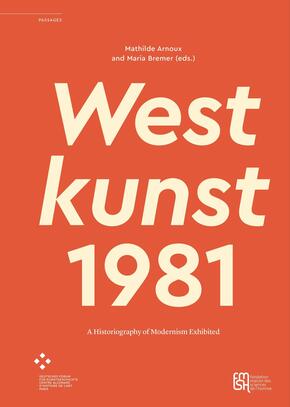
Westkunst, 1981 - A Historiography of Modernism Exhibited
Reduzierte Artikel in dieser Kategorie

5,99 €
15,99 €
10,99 €
5,99 €
10,99 €
| Verlag | diaphanes |
| Auflage | 17.04.2025 |
| Seiten | 304 |
| Format | 17,2 x 2,8 x 24,0 cm |
| Gewicht | 976 g |
| Artikeltyp | Englisches Buch |
| Reihe | Passages |
| EAN | 9782735130573 |
| Bestell-Nr | 73513057FA |
In 1981, the Cologne Trade-Fair centre hosted a large exhibition titled "Westkunst: Zeitgenössische Kunst seit 1939" (Western Art: Contemporary Art since 1939). Organized by art critic Laszlo Glozer and curator Kasper König, the Western-centric survey highlighted avant-garde art and politically charged themes of freedom and individual expression. By examining "Westkunst"’s historiographical stakes in light of the Iron Curtain division of Europe, the show is revealed as paradigmatic of the ways in which hegemonic concepts of ‘Western art’ and the accompanying processes of othering were fashioned in the art world. In this collective volume, "Westkunst"’s universalising claims are scrutinised by focusing on the artistic tendencies exhibited; on exhibitionary discourses and practices of decontextualisation, comparison, and appropriation; on the alleged realisation of the values of progress, freedom, and autonomy; on the enacted conceptions of temporality and the architectural devices of narrativisation; on the exhibition’s blind spots and exclusions and the critical reactions it elicited. This analytic output makes fresh use of the archival materials, which are neither centralised nor systematized, with significant excerpts republished throughout the book. Seen through the lens of exhibition history, this revisiting of "Westkunst" sheds light on a broader trend of cultural conservatism that was gaining strength in the 1980s, just before the end of the Cold War, and on the start of new forms of globalisation.
