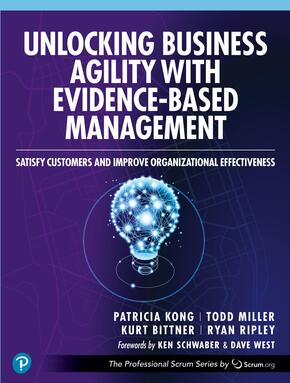
Unlocking Business Agility with Evidence-Based Management: Satisfy Customers and Improve Organizational Effectiveness
Reduzierte Artikel in dieser Kategorie

7,99 €
7,99 €
7,99 €
6,99 €
| Verlag | Pearson Education |
| Auflage | 2024 |
| Seiten | 224 |
| Format | 18,0 x 23,0 x 2,0 cm |
| Gewicht | 402 g |
| Artikeltyp | Englisches Buch |
| EAN | 9780138244576 |
| Bestell-Nr | 13824457EA |
Leverage Evidence-Based Management, a scientific method, to enable organizations to achieve goals under conditions of uncertainty.
Organizations often believe in the certainty of their plans and see every deviation from the plan as a sign of failure. They view the organization as a machine for creating and executing plans instead of looking at it as a responsive organism, attentive to the changes in its environment. In a world of uncertainties, organizations need to be capable of reinventing themselves every day based on new information.
In Unlocking Business Agility with Evidence-Based Management, authors Patricia Kong, Todd Miller, Kurt Bittner, and Ryan Ripley use the framework developed by Scrum.org called Evidence-Based Management (EBM). EBM is an empirical approach that helps organizations use experimentation and rapid feedback to progress toward goals. This path is not always obvious or straightforward, but that is a benefit: in a complex and changing world, the path toward goals will always be uncertain. EBM helps organizations use new data to adapt their plan toward their goals.
Throughout the book, the authors present stories and experiences that illustrate how EBM can be applied to set better goals and then leverage empiricism to achieve those goals using feedback, learning, and evidence. This definitive guide will help your organization identify its true purpose, improve its ability to reach goals, and build a culture of trust, transparency, and growth.
- Clarify goals and demonstrate value, success, and progress using agile metrics
- Progress toward goals in uncertain and rapidly changing circumstances
- Embrace empiricism and experimentation to find solutions for complex problems
- Find real-world anonymized case studies on how to articulate goals and measurements in a way that fosters self-management and business agility
Register your book for convenient access to downloads, updates, and/or corrections as they become available. See inside book for details.
Inhaltsverzeichnis:
Foreword by Ken Schwaber xi
Foreword by Dave West xv
Preface xix
Introduction xxvii
Chapter 1: Finding Purpose 1
Rediscovering Purpose 3
Goals 4
How Goals and Measures Influence Behaviors 7
How to Rediscover Purpose 10
Closing Satisfaction Gaps Creates Value 11
Customer-Focused Goals Enable Autonomy and Purpose 14
Improving Strategic Goals 17
Ask Why? to Uncover the Real Objective 17
Refocus Internal Goals on What Customers Need to Experience 19
Think About How You Will Measure Progress Toward Your Vision 20
What to Watch For 21
Moving Forward 22
Chapter 2: Using Empiricism to Progress Toward Goals 23
Understanding Value 25
Progressing Toward Goals in a Series of Small Steps 27
Taking Small Steps Toward Goals 29
Steering Toward Goals 32
Adapting Goals 34
Adapting Tactics 36
The Real Purpose of Goals Is to Foster Conversations 36
Losing the Plot and Finding It Again 37
What to Watch For 38
Moving Forward 39
Chapter 3: Becoming (More) Effective 41
Value Is Essential, but Frequency Matters Too 42
It Is Not Delivery Speed That Is Important; It Is Feedback Speed 44
While Focusing on Speed, Do Not Lose Sight of Value 45
Speed Is Not Enough; Teams Must Also Be Effective 46
Too Many Things at Once 48
Where Should Teams Start? 50
Beware the Efficiency Trap 51
Balancing Speed and Effectiveness 52
Cutting Corners: Sometimes Necessary, Sometimes Fatal 53
What to Watch For 55
Moving Forward 56
Chapter 4: Managing and Overcoming Expectations 59
People Who Largely Seek to Validate Expectations Are Often Disappointed 60
Transforming Bad News into Just News 61
Letting Go of Expectations 64
Expectations Can Be Stubbornly Held 65
Replacing Meeting Expectations with Seeking Goals 68
Stakeholders and Transparency 69
How to Define and Categorize Stakeholders
