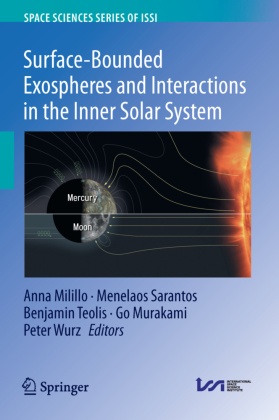
Studying the evolution of the surfaces and atmospheres of planetary bodies in the solar system is fundamental to our understanding of the present state of the solar system. Exospheres are the interfaces between the planetary body and the open space, so that, studying the exospheric filling and loss processes is the way to expand knowledge of the body's evolution. Surface and atmospheric changes are caused predominantly by the continuous bombardment of the bodies by photons, energetic ions, and micrometeoroids. Eventually, the ongoing processes are functions of the space environment, in other words, the planets are subjected to space weather.
This book focuses on the large subset of planetary objects (planets, moons, and small bodies) that are not protected by either strong magnetic fields or thick atmospheres in the inner solar system where the solar influence is stronger. The main exponents class regarding this class of objects are Mercury and the Moon. In these cases, the exosphere is directly connected to the surface, thus, it is called a surface-bounded exosphere. This is due to the surface release processes that are also the exospheric filling ones, where atoms and molecules collide with the surface far more frequently than collisions with each other.
During the last decade, several space missions provided important new findings for many airless bodies. Furthermore, new ground-based imaging techniques offered the possibility of improved exosphere observations. In the next decade, the ESA-JAXA BepiColombo mission will explore Mercury utilizing two spacecraft. And on a global scale, almost all space agencies will foresee orbiters and landers to the Moon as part of their space programs.
This collection of articles summarizes the current state of knowledge on surface-bounded exospheres, as a support for the interpretation of data that will be received from the forthcoming missions, for the next-generation of scientists that will be involved in the exploration of Mercury, the Moon and other airless bodies, including exoplanets.
Reprinted from the Space Science Reviews Topical Collection Surface-Bounded Exospheres and Interactions in the Inner Solar System
Inhaltsverzeichnis:
Editorial to "Surface-Bounded Exospheres and Interactions in the Inner Solar System".- Particles and photons as drivers: Comparison between Moon and Mercury.- Surface Exospheric Interactions.- Meteoroids as one of the sources for exosphere formation on airless bodies in the inner solar system.- Volatiles and refractories in surface-bounded exospheres in the inner Solar System.- Comparative Na and K Mercury and Moon exospheres.- Water Group Exospheres and Surface Interactions on the Moon, Mercury, and Ceres.- The Exosphere as a Boundary: Origin and Evolution of Airless Bodies in the Inner Solar System and Beyond Including Planets with Silicate Atmospheres.- Future directions for the investigation of surface-bounded exospheres in the inner Solar.
Anna Milillo has got a Laurea in Physics (1992) at "La Sapienza University in Rome. She has got a master and fellowships from the Italian Space Agency and from National Research Council in Rome between 1993 and 1999. Since 1999, she is a research scientist (senior scientists from 2019) at the Institute of Space Astrophysics and Planetology of INAF, previously called Institute of Interplanetary Space Physics (IFSI) of CNR. She has been Co-I of particle detection instruments for space missions of ESA to Earth, Mars and Venus and PI and Co-I on mission proposed to ESA and NASA for Earth, Moon, Jupiter's moons, asteroids. Since 2001, her major field of investigation is Mercury's environment and its interaction with the Sun and exosphere generation processes in the frame of BepiColombo ESA cornerstone and JAXA mission. She is coordinator of the Hermean Environment WG and BepiColombo InterDisciplinary Scientist (up to 2024), Deputy PI (up to 2024), national responsible of the BepiColombo/SERENA particle package and SERENA PI from October 2024, she is Co-I of the UV spectrometer PHEBUS and the X-rays and energetic particle detector SIXS. She is expert in environments of the bodies in the Solar System, investigating interactions between the ions, radiation and micrometeoroids with magnetospheres, upper atmospheres/exospheres/surfaces. She is author of about 130 refereed publications.
Menelaos Sarantos is an expert in the development of ion and neutral particle transport models for surface-boundary exospheres of the solar system. He is interested in studying the relative importance of sources and sinks for planetary exospheres and in understanding their links to their surrounding plasma and meteoroid environment. He has combined models with spacecraft measurements to derive microscopic parameters of the gas-surface interaction from macroscopic properties of the exospheres of the Moon and Mercury. He was a science team member of the NASA MESSENGER mission and a Guest Investigator for the LADEE mission. He is a a Guest Investigator on the Bepi Colombo mission.
Ben Teolis is a physicist, experimentalist, planetary scientist, and expert in planetary atmospheres and magnetospheres, and surface radiation processes on the frozen worlds of the outer solar system. As a Cassini spacecraft scientist for over a decade, he has published an extensive body of work on the Saturn system, its moons, and magnetosphere, and is today a Co-Investigator on Europa Clipper which will investigate surface and atmospheric composition, and search for possible plume-eruptions and habitable conditions. Dr. Teolis has authored/co-authored over 50 scientific papers covering an expansive set of subjects, ranging from spacecraft instrumentation, optics and thin films,chemical and radiation surface processing of icy planetary bodies, space plasma physics, and planetary exospheric structure and dynamics.
Go Murakami is an Assistant Professor working at Institute of Space and Astronautical Science (ISAS) in Japan Aerospace Exploration Agency (JAXA). He got his Ph.D by The University of Tokyo in 2011. Then he worked at JAXA/ISAS as a research fellow between 2011-2017 for developments and observations of Japanese ultraviolet space telescope Hisaki and the BepiColombo mission. In 2017 he got the current position at JAXA/ISAS and became the Project Scientist of the ESA-JAXA joint mission BepiColombo for Mercury Magnetospheric Orbiter: Mio. He is working on science management and observation planning of Mio. His science expertise is solar terrestrial plasma physics and planetary atmospheric science. He has developed ultraviolet spectroscopy and/or imaging instruments onboard Kaguya, Hisaki, and BepiColombo.
Peter Wurz has a degree in electronic engineering (1980), a M.Sc. (1985), and a Ph.D. in Physics from Technical University of Vienna, Austria (1990).
Autorenporträt schließen