Reduzierte Artikel in dieser Kategorie

0,99 €
5,99 €
5,99 €
5,99 €
5,99 €
| Verlag | Cambridge University Press |
| Auflage | 2017 |
| Seiten | 302 |
| Format | 17,4 x 24,6 x 1,2 cm |
| Gewicht | 630 g |
| Artikeltyp | Englisches Buch |
| Reihe | Cambridge Introductions to the English Language |
| ISBN-10 | 1107480167 |
| EAN | 9781107480162 |
| Bestell-Nr | 10748016UA |
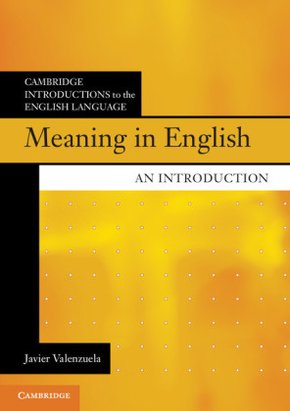
This lively, compact textbook introduces readers to semantics - the study of how we construct meaning in communication. Easy to follow, and with a clear structure, it explains formal terminology in a simple and understandable way, without using formal notation or logic, and draws on dozens of examples from up-to-date empirical research findings. Offering a tight integration of classic semantic issues with cognitive science, Javier Valenzuela provides a complete and coherent overview of the main topics in this area, including a review of the empirical methods used in semantic theorizing, and discussions of both non-traditional and new topics, such as how meaning is acquired by children and how meaning is constructed cross-linguistically. Featuring illustrations, exercises, activities, suggestions for further reading, highlighted key terms, and a comprehensive glossary, this book is accessible to beginners and undergraduates, including those from non-linguistic backgrounds with no prior knowledge of linguistic analysis. It will be an essential resource for courses in English language, English studies, linguistics and the cognitive sciences.
Inhaltsverzeichnis:
1. What is semantics?; 2. Analyzing meaning; 3. Language and thought; 4. Word meaning; 5. Meaning relations; 6. Acquisition of meaning and cross-linguistic meaning; 7. Figurative meaning; 8. Sentential meaning; 9. Discourse meaning and pragmatics.
