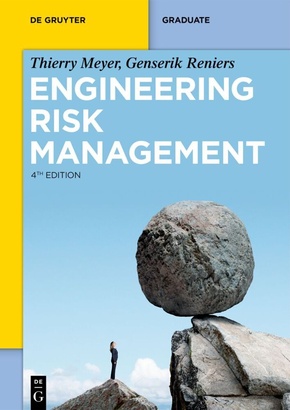
Engineering Risk Management - Optimizing Operational Risk Decision-Making, Safety and Reliability, Risk Assessment
Reduzierte Artikel in dieser Kategorie

4,99 €
2,99 €
10,99 €
0,99 €
0,99 €
5,99 €
0,99 €
11,99 €
8,99 €
13,99 €
12,99 €
3,99 €
24,99 €
27,99 €
15,99 €
13,99 €
44,99 €
13,99 €
8,99 €
22,99 €
| Verlag | De Gruyter |
| Auflage | 2025 |
| Seiten | 396 |
| Format | 17,0 x 2,5 x 24,2 cm |
| Großformatiges Paperback. Klappenbroschur | |
| Gewicht | 695 g |
| Artikeltyp | Englisches Buch |
| Reihe | De Gruyter Textbook |
| ISBN-10 | 3111490580 |
| EAN | 9783111490588 |
| Bestell-Nr | 11149058A |
This revised and updated 4th edition of Engineering Risk Management (ERM) presents an understanding and insights into what risk is, what it constitutes, and how to interpret the building blocks of the concept. It promotes a culture of risk awareness and integrating risk management principles and practices into the educational environment. This is essential to ensure that students have the knowledge and skills to identify hazards and assess and control risks in different contexts through the development and implementation of a risk management curriculum.
The book also elaborates on the differences between safety and security, and risk management metaphors. Models, theories and principles are discussed, as well as risk assessment methods, risk treatment, risk resilience and micro-economic approaches to optimizing risk decision-making. Some iconic major accidents are explained, followed by examples of practical implementation of ERM in chemistry, physics, and nanotechnology.
Overall, the interface between risk management and education is essential to develop a generation of professionals who can effectively deal with risks in a variety of contexts. By integrating risk management principles and practices into the educational process, educational institutions can help ensure, that their students are well prepared to meet the challenges of the modern world.
