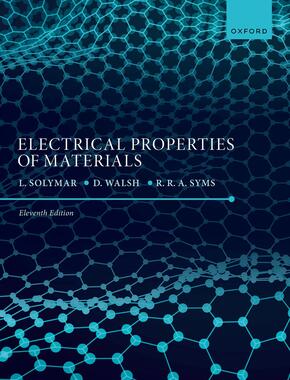
Electrical Properties of Materials
Reduzierte Artikel in dieser Kategorie

22,99 €
37,99 €
| Verlag | Oxford University Press |
| Auflage | 11. Auflage, 12.11.2024 |
| Seiten | 640 |
| Format | 19,0 x 2,8 x 24,5 cm |
| Print PDF | |
| Gewicht | 1318 g |
| Artikeltyp | Englisches Buch |
| EAN | 9780198920977 |
| Bestell-Nr | 19892097EA |
The electrical properties of materials are fundamental to many devices encountered in daily life and in today's industry, ranging from the semiconductors used in microelectronics to the dielectric materials in liquid crystal displays, the magnetic materials in the motors of electric cars and the superconducting materials in MRI scanners. All stem from the response of electrons to electric and magnetic fields.
This book explains the phenomena, reviews the best materials, and presents the most relevant applications. The behaviour of electrons in atoms, liquids, solids, and periodic crystals is described, and the possibilities of new artificial materials are discussed. In themselves, electrons are intriguing, sometimes displaying particle-type and other times wave-type behaviour. Full understanding of wave properties requires quantum mechanics, often seen as a barrier due to the unfamiliarity of the concepts involved and the complexity of the mathematical apparatus needed. A key aim is to overcome these difficulties. Underpinning theory is explained as simply as possible.
Classical and quantum mechanics are used as appropriate, in each case giving a full development and often presenting complementary viewpoints. Examples are presented in a comprehensive set of problems. This flexible approach allows full understanding both of fundamentals (for example, the properties of atoms in different columns of the periodic table) and of applications (the design of a new laser based on an artificially engineered band structure). The contents have been successfully refined over more than 50 years and are especially suitable for undergraduates and postgraduates in Materials and Electrical Engineering.
Inhalt:
- 1: The electron as a particle
- 2: The electron as a wave
- 3: The electron
- 4: The hydrogen atom and the periodic table
- 5: Bonds
- 6: The free electron theory of metals
- 7: The band theory of solids
- 8: Semiconductors
- 9: Principles of semiconductor devices
- 10: Dielectric materials
- 11: Magnetic materials
- 12: Lasers
- 13: Optoelectronics
- 14: Superconductivity
- 15: Metamaterials
- Epilogue
- Appendix I: Organic semiconductors
- Appendix II: Nobel laureates Appendix V: Thermoelectricity
- Appendix III: Physical constants
- Appendix IV: Variational calculus. Derivation of Euler s equation
- Appendix V: Thermoelectricity
- Appendix VI: Principles of the operation of computer memories
- Appendix VII: Medical imaging
- Appendix VIII: Suggestions for further reading
- Answers to exercises
