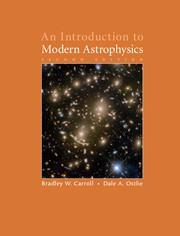
An Introduction to Modern Astrophysics
Reduzierte Artikel in dieser Kategorie

22,99 €
| Verlag | Cambridge University Press |
| Auflage | 2. Auflage, 07.09.2017 |
| Seiten | 1359 |
| Format | 20,3 x 25,2 x 5,1 cm |
| Gewicht | 2412 g |
| Artikeltyp | Englisches Buch |
| ISBN-10 | 1108422160 |
| EAN | 9781108422161 |
| Bestell-Nr | 10842216UA |
An Introduction to Modern Astrophysics is a comprehensive, well-organized and engaging text covering every major area of modern astrophysics, from the solar system and stellar astronomy to galactic and extragalactic astrophysics, and cosmology. Designed to provide students with a working knowledge of modern astrophysics, this textbook is suitable for astronomy and physics majors who have had a first-year introductory physics course with calculus. Featuring a brief summary of the main scientific discoveries that have led to our current understanding of the universe; worked examples to facilitate the understanding of the concepts presented in the book; end-of-chapter problems to practice the skills acquired; and computational exercises to numerically model astronomical systems, the second edition of An Introduction to Modern Astrophysics is the go-to textbook for learning the core astrophysics curriculum as well as the many advances in the field.
Inhalt:
Preface; Part I. The Tools of Astronomy: 1. The celestial sphere; 2. Celestial mechanics; 3. The continuous spectrum of light; 4. The theory of special relativity; 5. The interaction of light and matter; 6. Telescopes; Part II. The Nature of Stars: 7. Binary systems and stellar parameters; 8. The classification of stellar spectra; 9. Stellar atmospheres; 10. The interiors of stars; 11. The Sun; 12. The interstellar medium and star formation; 13. Main sequence and post-main-sequence stellar evolution; 14. Stellar pulsation; 15. The fate of massive stars; 16. The degenerate remnants of stars; 17. General relativity and black holes; 18. Close binary star systems; Part III. The Solar System: 19. Physical processes in the solar system; 20. The terrestrial planets; 21. The realms of the giant planets; 22. Minor bodies of the solar system; 23. Formation of planetary systems; Part IV. Galaxies and the Universe: 24. The Milky Way Galaxy; 25. The nature of galaxies; 26. Galactic evolution; 27. The structure of the Universe; 28. Active galaxies; 29. Cosmology; 30. The early Universe; Appendix A. Astronomical and physical constants; Appendix B. Unit conversions; Appendix C. Solar system data; Appendix D. The constellations; Appendix E. The brightest stars; Appendix F. The nearest stars; Appendix G. Stellar data; Appendix H. The Messier catalog; Appendix I. Constants, a programming module; Appendix J. Orbit, a planetary orbit code; Appendix K. TwoStars, a binary star code; Appendix L. StatStar, a stellar structure code; Appendix M. Galaxy, a tidal interaction code; Appendix N. WMAP Data; Suggested reading; Index.
