
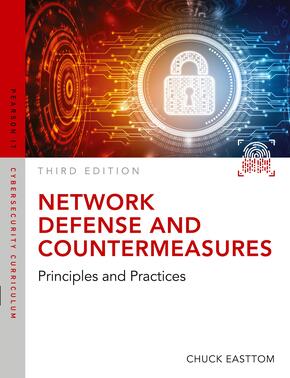
Network Defense and Countermeasures: Principles and Practices
Reduzierte Artikel in dieser Kategorie
| Verlag | Pearson Education |
| Auflage | 2024 |
| Seiten | 544 |
| Format | 17,8 x 23,1 x 3,4 cm |
| Gewicht | 848 g |
| Artikeltyp | Englisches Buch |
| EAN | 9780789759962 |
| Bestell-Nr | 78975996EA |
All you need to know about defending networks, in one book
· Clearly explains concepts, terminology, challenges, tools, and skills
· Covers key security standards and models for business and government
· The perfect introduction for all network/computer security professionals and students
Welcome to todays most useful and practical introduction to defending modern networks. Drawing on decades of experience, Chuck Easttom brings together updated coverage of all the concepts, terminology, techniques, and solutions youll need to be effective.
Easttom thoroughly introduces the core technologies of modern network security, including firewalls, intrusion-detection systems, and VPNs. Next, he shows how encryption can be used to safeguard data as it moves across networks.
Youll learn how to harden operating systems, defend against malware and network attacks, establish robust security policies, and assess network security using industry-leading standards and models. Youll also find thorough coverage of key issues such as physical security, forensics, and cyberterrorism.
Throughout, Easttom blends theory and application, helping you understand both what to do and why. In every chapter, quizzes, exercises, projects, and web resources deepen your understanding and help you use what youve learnedin the classroom and in your career.
Learn How To
· Evaluate key network risks and dangers
· Choose the right network security approach for your organization
· Anticipate and counter widespread network attacks, including those based on social engineering
· Successfully deploy and apply firewalls and intrusion detection systems
· Secure network communication with virtual private networks
· Protect data with cryptographic public/private key systems, digital signatures, and certificates
· Defend against malware, including ransomware, Trojan horses, and spyware
· Harden operating systems and keep their security up to date
· Define and implement security policies that reduce risk
· Explore leading security standards and models, including ISO and NIST standards
· Prepare for an investigation if your network has been attacked
· Understand the growing risks of espionage and cyberterrorism
Inhaltsverzeichnis:
Chapter 1: Introduction to Network Security
Introduction
The Basics of a Network
Basic Network Structure
Data Packets
IP Addresses
Uniform Resource Locators
MAC Addresses
Protocols
Basic Network Utilities
ipconfig
ping
tracert
netstat
The OSI Model
What Does This Mean for Security?
Assessing Likely Threats to the Network
Classifications of Threats
Malware
Compromising System Security Intrusions
Denial of Service
Likely Attacks
Threat Assessment
Understanding Security Terminology
Hacking Terminology
Security Terminology
Choosing a Network Security Approach
Perimeter Security Approach
Layered Security Approach
Hybrid Security Approach
Network Security and the Law
Using Security Resources
Summary
Chapter 2: Types of Attacks
Introduction
Understanding Denial of Service Attacks
DoS in Action
SYN Flood
Smurf Attack
Ping of Death
UDP Flood
ICMP Flood
DHCP Starvation
HTTP Post DoS
PDoS
Distributed Reflection Denial of Service
DoS Tools
Real-World Examples
Defending Against DoS Attacks
Defending Against Buffer Overflow Attacks
Defending Against IP Spoofing
Defending Against Session Hijacking
Blocking Virus and Trojan Horse Attacks
Viruses
Types of Viruses
Trojan Horses
Summary
Chapter 3: Fundamentals of Firewalls
Introduction
What Is a Firewall?
Types of Firewalls
Packet Filtering Firewall
Stateful Packet Inspection
Application Gateway
Circuit Level Gateway
Hybrid Firewalls
