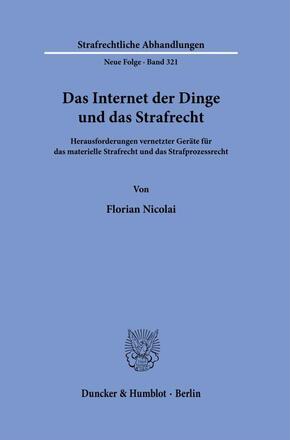
Das Internet der Dinge und das Strafrecht - Herausforderungen vernetzter Geräte für das materielle Strafrecht und das Strafprozessrecht
Reduzierte Artikel in dieser Kategorie

21,99 €
| Verlag | Duncker & Humblot |
| Auflage | 1. Auflage, 28.07.2024 |
| Seiten | 408 |
| Format | 15,7 x 2,0 x 23,2 cm |
| Gewicht | 605 g |
| Reihe | Strafrechtliche Abhandlungen. Neue Folge |
| ISBN-10 | 3428190564 |
| ISBN-13 | 9783428190560 |
| Bestell-Nr | 42819056A |
'The Internet of Things and the Criminal Law. Challenges Smart Devices Pose to both Substantive Criminal Law and Criminal Procedural Law': The interconnectedness of everyday life via the Internet of Things poses new challenges to both substantive criminal law and criminal procedural law. This study addresses, from a substantive law perspective, the question of how criminal law can protect data and devices within the Internet of Things. From a procedural standpoint, it discusses the extent to which technically feasible investigative measures utilizing data and devices of the Internet of Things are admissible.
Inhalt:
Einleitung: Smarte Geräte - Smartes Strafrecht?
1. Rechtstatsächliche Grundlagen
Das Internet der Dinge (IoT) - Der Bezug zum Strafrecht - Das Strafrecht der Dinge
2. Das Internet der Dinge und das materielle Strafrecht
Materiellrechtliche Herausforderungen - Aktuelle Reformbestrebungen des Gesetzgebers - Fazit der materiellrechtlichen Betrachtungen
3. Das Internet der Dinge und das Strafprozessrecht
Das Internet der Dinge als digitale Ermittlungsperson - Grundrechtsschutz von IoT-Daten und Systemen - Strafprozessuale Eingriffsnormen für den Zugriff auf Daten, Geräte und Systeme des IoT - Strafprozessuale Grundsätze und Grenzen im Zusammenhang mit dem IoT - Fazit der strafprozessualen Betrachtungen
Schlussbemerkungen
Literatur- und Sachwortverzeichnis
